
Coming Home to Your Body After Survival Learning Safety Again

Tangible ways to reduce stress, to feel safe in the body again
For a long time, survival can feel like strength. You keep going. You answer the message. You make the appointment. You stay useful, calm, funny, capable, quiet, busy, numb, or whatever the moment asks of you. Then one day, when the danger has passed or life has softened a little, your body does not always get the news. You might wake with a tight jaw. You might hold your breath without noticing. You might feel tired after a full night of sleep, startled by small sounds, or oddly detached when someone asks, “How are you?” The honest answer may be, “I don’t know. I can’t really feel myself.” Coming home to your body after years of survival is not a neat self-care project. It is often slow, tender, and confusing. It can feel like learning a language you once knew but had to forget. This piece is informational only and not a replacement for medical or mental health care. If body reconnecting brings up distress, trauma memories, panic, or thoughts of self-harm, support from a qualified professional can make the process safer.

Survival teaches the body to stay ready
Chronic stress changes the way a person moves through the world. The nervous system is built to protect us. When it senses threat, it can mobilise the body to fight, flee, freeze, please, or shut down. These responses are not character flaws. They are intelligent adaptations. A child who grows up around unpredictability may learn to scan faces before entering a room. An adult in a long season of caregiving may ignore hunger, pain, and exhaustion because someone else’s needs feel more urgent. Someone who has lived through loss, illness, conflict, financial strain, discrimination, or emotional neglect may become very good at functioning while disconnected from their own inner signals. That disconnection can look different for each person. It might show up as: • Living mostly in the head, planning and analysing everything • Feeling numb or blank during emotional moments • Struggling to notice hunger, fullness, tiredness, or tension • Keeping constantly busy because stillness feels unsafe • Feeling guilty when resting • Being surprised by tears, anger, or panic that seem to come from nowhere • Treating the body like a machine that should simply keep performing One person I know described it as “driving a car with the dashboard covered”. The engine was overheating. The fuel light was on. The tyres were worn. But they could not see the signals, so they kept driving. For years, that worked. Until it didn’t.
Coping mechanisms can protect us and distance us from ourselves
Coping mechanisms often begin as care. Even the ones that later cause harm may have helped us get through a time when we had few better options. Overworking can create a sense of control. People-pleasing can reduce conflict. Emotional eating can bring comfort. Naming out with television, scrolling, alcohol, shopping, or constant noise can offer relief from feelings that once seemed too much to hold. The problem is not that people cope. The problem is that some coping strategies keep the body quiet for so long that self-awareness becomes hard to access. I remember a period when I could tell you exactly what everyone around me needed, but I could not tell you whether I was hungry. I knew how to read the mood in a room within seconds. I knew when to soften my voice, when to disappear, when to push through. If someone asked what I wanted for dinner, I felt embarrassed by how hard the question was. At the time, I thought this meant I was easy-going. Later, I realised I had practised leaving myself. That kind of leaving can become familiar. The body may become a place to manage rather than inhabit. Headaches, stomach issues, muscle tension, disrupted sleep, and fatigue may be treated as inconveniences rather than messages. Of course, physical symptoms can have many causes, and it is wise to speak with a healthcare professional about ongoing concerns. Still, chronic stress can place a heavy load on the body. When survival has trained us to ignore inner signals, healing often begins with making those signals matter again.
Nervous-system regulation means building a felt sense of safety
Nervous-system regulation is not about being calm all the time. No healthy nervous system stays perfectly peaceful. A regulated nervous system can move between activation and rest with more flexibility. It can feel stress, respond, and then return. After chronic stress, the body may need many small experiences of safety before it trusts that the threat has changed. Safety is not only an idea. It is also a sensation. You may know, logically, that you are safe in your home, with kind people, in a more stable season. Yet your shoulders may still rise towards your ears. Your stomach may still brace. Your sleep may still feel light. The body often believes repeated experience more than explanation. This is why simple practices can matter. A slow exhale. A warm drink held in both hands. Feeling your feet on the floor. Looking around the room and naming what is true now. These acts may seem small, but they teach the nervous system through repetition. The body often learns safety through moments, not lectures.
Reconnecting can feel uncomfortable at first
There is a reason many people avoid slowing down. When the noise drops, the body may speak. At first, reconnecting may not feel peaceful. It may feel irritating, sad, restless, or even frightening. A quiet meditation might reveal a racing heart. A yoga class might bring unexpected tears. A body scan might uncover tightness that has been there for years. This does not mean the practice is failing. It may mean awareness is returning. A friend once told me they stopped going for walks without headphones because silence made them feel “too present”. Their chest tightened. Thoughts rushed in. They felt exposed, as if something bad would happen if they were not distracted. So they began with two minutes. No dramatic transformation. No big declaration. Just two minutes walking down the road without audio, noticing shoes on pavement, cold air on cheeks, hands in pockets. Then they put the headphones back in. After a while, two minutes became five. Then ten. The aim was not to become a different person. It was to give the body proof that presence could be survivable. That is often how returning happens, not all at once, but in small tolerable doses.

Start with body awareness that feels manageable
Body awareness exercises do not need to be long or intense. In fact, for people with a history of trauma or chronic stress, gentleness matters. Try beginning with neutral or pleasant sensations before turning towards pain or tension.
Notice contact points
Sit or stand somewhere reasonably comfortable. Notice where your body meets support. Feel: • Feet on the floor • Back against a chair • Hands resting on fabric • Clothing touching skin • The weight of your body being held You do not need to relax. You only need to notice. If the body softens, let it. If it does not, that is still useful information.
Use the room as an anchor
Look around slowly and name five ordinary objects. Choose things that do not carry emotional weight. For example: • Blue mug • Wooden door • Green plant • Cream wall • Grey blanket This can help orient the nervous system to the present moment. It gently says, “I am here, now.”
Try a short body scan with choice
A traditional body scan can feel too exposed for some people. Choice helps. Start with one area that feels easy or neutral, such as hands, feet, or shoulders. Ask: • What do I notice here? • Is there warmth, coolness, pressure, tingling, tightness, or nothing much? • Do I want to stay with this sensation or move on? That last question matters. Reconnecting with the body should include consent. You are allowed to pause.
Practise self-compassion when old patterns appear
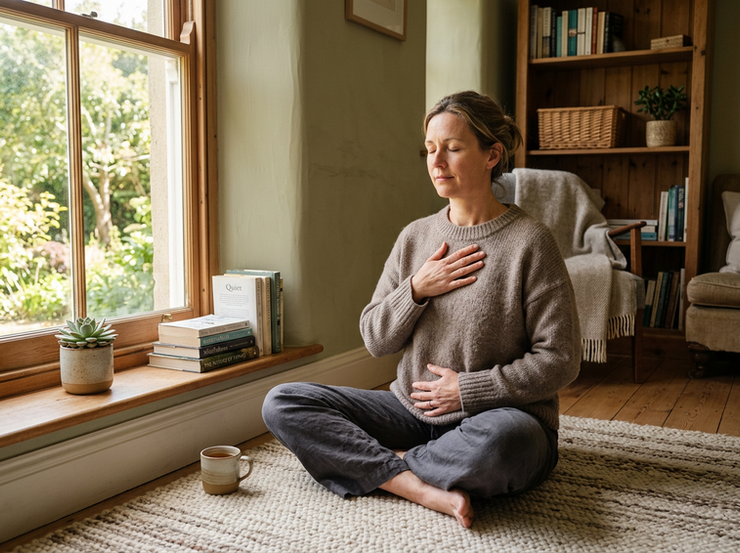
When people begin to feel again, they often meet grief. Grief for the years spent bracing. Grief for the needs that went unmet. Grief for the body that carried so much without thanks. Self-compassion is not self-pity. It is a way of relating to yourself without adding shame to pain. A useful question is, “What did this coping mechanism do for me?” The answer might be: • Staying busy helped me avoid collapsing • Numbing helped me get through evenings alone • People-pleasing helped me reduce conflict • Perfectionism helped me feel less vulnerable • Detachment helped me survive what I could not change This does not mean every coping strategy should stay. Some will need to be softened, replaced, or supported with professional help. But contempt rarely heals them. Curiosity gives you more room. You might place a hand on your chest and say quietly: “I understand why I learnt this.” Or: “Something in me has been trying to protect me.” At first, this may feel awkward. That is fine. Many practices feel strange before they feel true.
Build small rituals of safety into the day
The nervous system responds well to rhythm. Small, repeated cues can help the body recognise steadier ground. Here are a few simple rituals to try.
Begin the morning before reaching for noise
Before looking at a phone, place both feet on the floor. Take three slow breaths. Notice the light in the room. Ask, “What does my body need in the next hour?” The answer may be water, food, stretching, quiet, medication, a jumper, or a slower pace.
Take one regulated pause
Choose one daily activity and slow it down by ten per cent. Drinking tea. Washing hands. Locking the front door. Sitting in the car before going inside. Let that ordinary act become a reminder that you exist in a body, not only in a list of tasks.
Soften the exhale
Longer exhales can signal settling to the body. Try breathing in gently, then breathing out a little longer than usual. Do not force it. Keep it comfortable. If breathwork makes you anxious, use another anchor. Feel your feet. Hold a warm mug. Press your palms together. Regulation has many doors.
Move in ways that feel respectful
Movement can rebuild trust when it is guided by listening rather than punishment. Try: • Slow stretching • Gentle walking • Shaking out the hands and arms • Swaying to music • Resting in a supported position • Noticing when the body says “enough” The goal is not performance. The goal is relationship.
Let support be part of coming home
Some bodies have carried too much alone. Reconnecting can be easier with safe support. That support may include therapy, trauma-informed bodywork, a trusted GP, a support group, a gentle movement teacher, or one person who can listen without rushing to fix. For some people, approaches that include the body may be especially helpful, provided they are offered by trained practitioners and feel safe enough to try. The key word is safe enough. Not perfect. Not instant trust. Safe enough to have choice, boundaries, and the ability to stop. When you have spent years overriding yourself, saying “no”, “not today”, or “I need a break” can become part of healing.
Feeling at home in yourself is built slowly
Coming home to the body is not a final destination where stress never returns. Life will still bring noise, pressure, loss, and uncertainty. The difference is that over time, you may notice your signals sooner. You may pause before abandoning yourself. You may recognise tension as communication rather than failure. You may begin to feel hunger before you become shaky. Tiredness before you crash. Anger before it turns into resentment. Sadness before it becomes numbness. You may discover that your body is not the enemy. It is the place that kept trying to carry you. Start small. Put one hand on your chest. Feel your feet. Look around the room. Let your body take in one true thing about this moment. You are here. And little by little, here can become a place you know how to live.
Introducing you to the "Overcoming Overwhelm" Course
In response to the chronic stress I see in my patients, I have create a 6-week program designed to help you manage stress and thus start empowering you with the tools that helped me recover form paralysis and rebuild my life. In this course, you'll engage in guided practices, insightful discussions, and practical strategies that will empower you to identify what’s causing your overwhelm and develop effective coping techniques - enabling you to access pockets of joy, and supporting your physiology to reduce the stress load.
What You'll Explore
• Understanding the Nature of Overwhelm • Identifying Your Personal Triggers • Mindfulness Techniques for Relaxation • Time Management Skills and Prioritization Tips • Building Resilience and Emotional Intelligence • Creating Your Personalized Action Plan
Course Duration
This engaging program spans 6 weeks, with weekly sessions that build on each topic, equipping you with the tools you need to manage overwhelm with confidence.
Who Should Join?
If you feel stuck in your body, and are experiencing chronic health issues - despite having ' tried everything' this course is for you. Its gentle, powerful and deeply potent.


Comments